


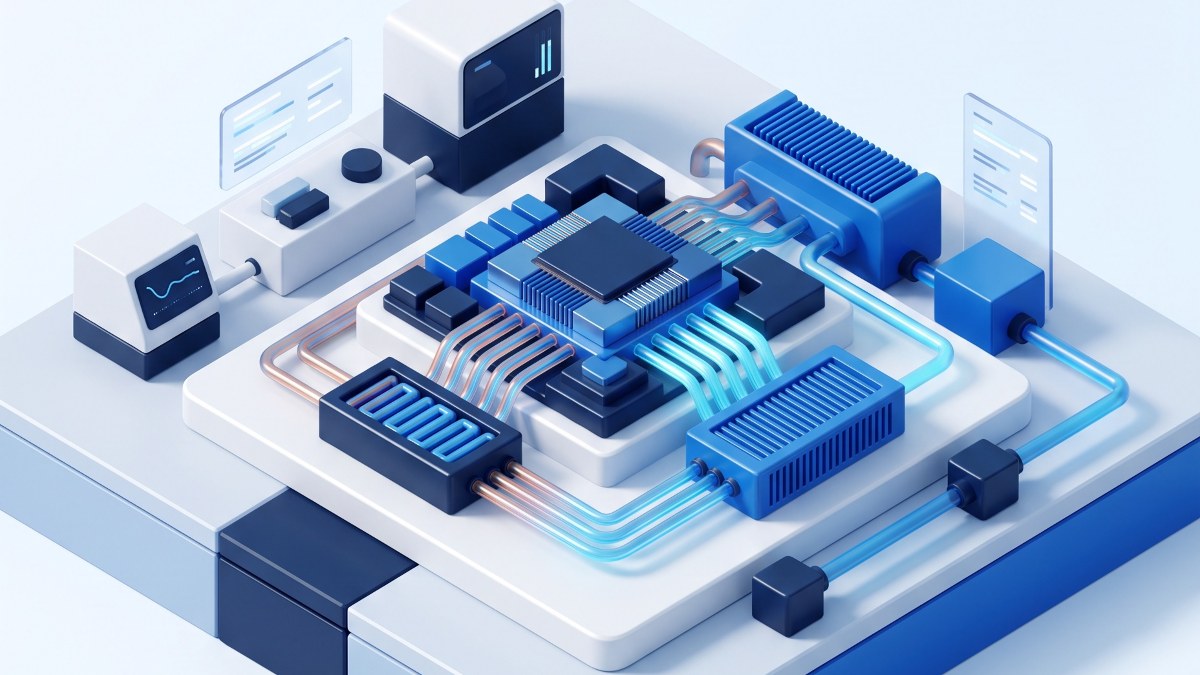
When heat becomes a bottleneck for technology
In corporate environments, system performance depends on a chain that goes far beyond software. More demanding processors, data center infrastructure, and high thermal-density equipment face a constant challenge: dissipating heat efficiently without increasing complexity, power consumption, and operational risk.
That is the context in which research from Osaka Metropolitan University in Japan is drawing attention. The study, published in the scientific journal Laser & Photonics Reviews, presents a thermal device capable of controlling the direction in which heat is radiated and maintaining its configuration even after being disconnected from power.
What makes this discovery relevant
The most interesting aspect of the technology is not just controlling heat, but doing so without relying on continuous electricity consumption after it has been configured. In other words, the device “remembers” its thermal programming, opening the door to more efficient solutions in scenarios where temperature control is critical.
According to the source, the prototype uses indium arsenide (InAs) and GST, a phase-change material. This combination points to an advanced engineering approach designed to manipulate thermal behavior precisely at the laboratory level.
For companies that operate digital infrastructure, this matters because heat is not just a physical issue: it affects stability, component lifespan, processing density, and even the predictability of operating costs.
Why data centers and chips are at the center of this discussion
Data centers and high-performance chips are under growing pressure to become more efficient. More processing means more heat. More heat means more cooling. And more cooling means greater design complexity, more points of failure, and higher operational demands.
A technology capable of intelligently directing thermal dissipation could, in the future, help reduce waste and improve system design. It would not replace existing cooling infrastructure, but it could complement thermal engineering strategy with a more precise layer of control.
In practice, the potential impact goes beyond hardware. More efficient thermal dissipation solutions could support more robust, sustainable, and scalable digital operations — something especially relevant for companies that rely on critical applications, automation, and cloud services.
What companies should watch now
Despite the potential, the news itself makes it clear that the technology is still at the laboratory stage. That means there is still a long path before broad commercial adoption, including durability validation, integration with real-world systems, and feasibility at scale.
Even so, keeping an eye on this kind of advancement is strategic. Innovations in materials, electronics, and thermal management often directly influence the future of digital infrastructure. Many times, what seems distant today becomes a competitive advantage once it matures.
- Thermal efficiency is part of digital performance.
- Less heat can mean greater operational stability.
- Advanced materials tend to redefine hardware design.
- Data centers and chips require increasingly precise solutions.
View from SuaEmpresa.Net
At SuaEmpresa.Net, we see this news as an important reminder: technological innovation does not happen only in the visible layer of interfaces and applications. It also begins behind the scenes, in the infrastructure that supports everything a company delivers to the market.
For organizations investing in digital transformation, following advances like this helps anticipate trends in performance, sustainability, and scalability. In a scenario increasingly dependent on processing and data, controlling heat intelligently can be just as relevant as optimizing code or automating processes.
The future of enterprise technology depends on solutions that do more with less energy, less friction, and more predictability. And this research points exactly in that direction.
Source: Canaltech