


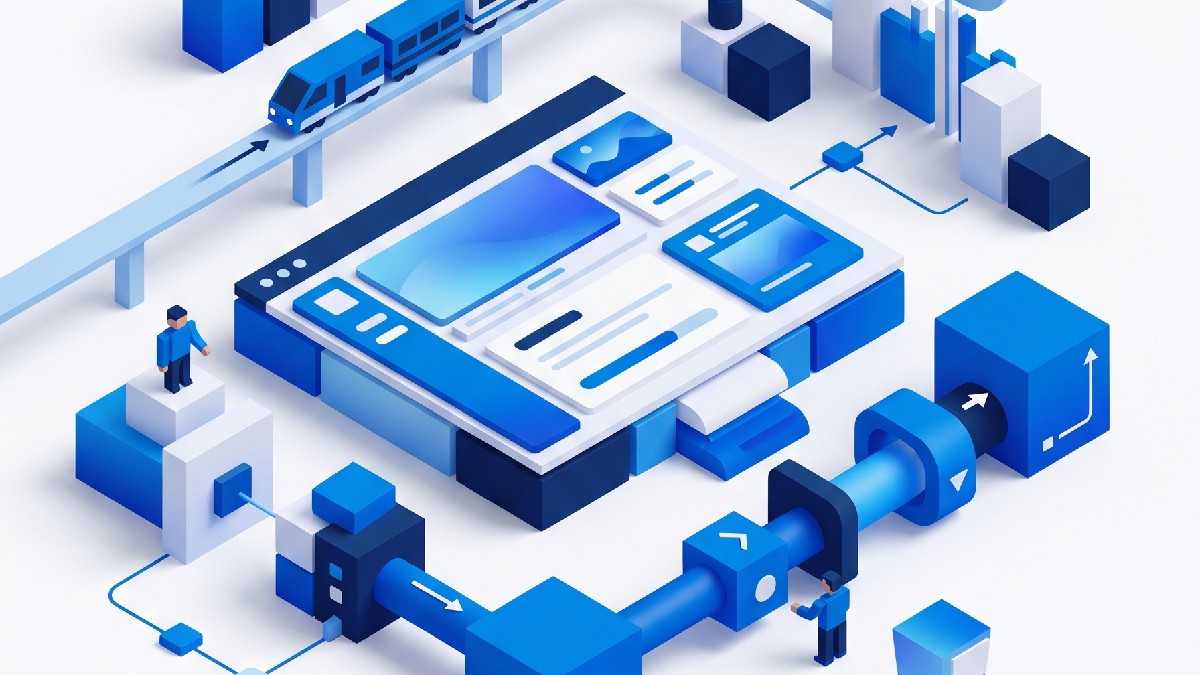
In 2026, having a beautiful website is no longer enough. What really separates growing companies from those that only maintain a presence is the ability to turn the website into a sales, service, and operations tool. SuaEmpresa.Net works exactly at this point: creating digital experiences that help the business run better from the user's very first visit.
Today, web development needs to go far beyond visuals. It must consider speed, clear navigation, system integration, security, and the ability to adapt to customer behavior. When these elements work together, the website stops being a showcase and becomes a strategic asset for the company.
This scenario is even more important because audiences are more demanding and make decisions quickly. If the page is slow, confusing, or fails to inspire trust, the opportunity is lost. That is why a modern web project needs to be built with results in mind, not just appearance.
Web development in 2026: the website needs to be fast, clear, and ready to convert
Speed remains one of the most important factors in any digital project. A slow website hurts the experience, increases abandonment rates, and undermines marketing campaigns, even when the ad is well targeted. In many cases, the problem is not the promotion itself, but the landing page that does not meet visitor expectations.
Beyond speed, message clarity has become even more important. The user needs to understand within seconds what the company does, who it serves, and what the next step is. This requires a well-planned information architecture, with objective menus, visible calls to action, and content organized in a logical way.
Another essential point is conversion. A modern website should guide the visitor naturally toward contact, a quote, or a purchase. This involves well-designed forms, service pages with strong arguments, and integration with analytics tools to identify where users move forward and where they drop off.
Practical example: a service company can have a streamlined homepage, a dedicated page for each solution, and a short form at the end of each section. This model usually makes decision-making easier because it reduces distractions and reinforces the value proposition. To structure this efficiently, it is worth exploring solutions such as website and web systems development.
Smart integrations: when the website talks to systems, sales, and support
One of the biggest advantages of modern web development is integration. The website does not need to work in isolation; it can connect to CRM, ERP, automation tools, chatbots, marketing platforms, and payment gateways. When that happens, the company reduces rework and gains more control over the customer journey.
In practice, this means that an order placed on the website can automatically go to the responsible department, a lead can enter an organized database, and support can respond with more context. Instead of manual and scattered processes, the business operates more smoothly. This improves not only productivity, but also the perception of professionalism.
Integrations also help drive better decisions. When browsing data, forms, and sales are centralized, it becomes easier to understand which channels generate results and which pages need adjustments. This insight is valuable for companies investing in growth and not wanting to rely on assumptions.
When is it worth integrating the website with other solutions?
If the company receives many inquiries per day, works with custom quotes, or handles recurring support steps, integration stops being a luxury and becomes a necessity. It reduces errors, speeds up customer responses, and improves internal organization. In businesses with high interaction volume, this operational gain is usually immediate.
It also makes sense to integrate the website when the operation depends on real-time updated data. This is common in e-commerce, scheduling systems, restricted areas, and customer portals. In these cases, the user experience depends directly on the quality of the connection between front-end, back-end, and infrastructure.
For projects that require more flexibility, it is worth considering resources such as apps, artificial intelligence, APIs, and innovations, especially when the goal is to automate tasks and create smarter journeys.
Websites for e-commerce and services: the digital experience must support the business
Not every website has the same goal, and that is a common mistake in poorly planned projects. A corporate website, a service portal, and an online store have different needs, even though they share similar principles. The ideal structure always depends on the journey the company wants to create for the user.
In e-commerce, for example, the experience needs to be extremely straightforward. The customer wants to find the product quickly, compare options, view clear information, and complete the purchase without friction. In services, the focus is usually trust, authority, and lead generation. In both cases, the technical foundation must support simple and secure navigation.
Another important aspect is scalability. A well-built website today should remain useful as the business grows, receives more traffic, or expands its catalog. This avoids rework and reduces future costs with emergency redesigns. Designing with expansion in mind is one of the smartest ways to protect digital investment.
What can’t be missing from a modern online store?
An efficient online store needs well-organized categories, functional search, a simplified checkout, and integration with reliable payment methods. It is also important that the website be responsive, with good readability on smartphones and tablets, since mobile browsing is a central part of the consumer journey.
In addition, clear product descriptions, quality images, and social proof help reduce purchase hesitation. When the store inspires trust and quickly answers customer questions, conversion improves consistently. For companies that want to sell better with a solid structure, the online store development and management page can be a strategic starting point.
In businesses with a broad catalog or more complex operations, it is also worth considering automations that reduce repetitive tasks. This allows the sales team and support team to focus on what truly requires human intervention.
Cloud, performance, and security: the invisible foundation that supports digital results
Many business owners only realize the importance of infrastructure when something goes wrong. However, the technical foundation is what ensures availability, stability, and fast response even during periods of higher demand. In 2026, this makes a difference for both corporate websites and internal systems and online stores.
Cloud hosting, on-demand scalability, and continuous monitoring help prevent outages and keep operations running. This is especially relevant for companies that depend on the digital channel to sell, provide support, or capture leads. When infrastructure fails, the problem is not just technical; it affects revenue, reputation, and trust.
Security also needs to be at the center of decisions. Certificates, update routines, access control, and data protection best practices reduce risks and strengthen the company’s credibility. In an increasingly connected environment, taking care of the technical foundation is just as important as taking care of communication.
For businesses that want to grow predictably, high-performance cloud servers help keep the website stable, scalable, and ready for traffic spikes.
A modern website should not just look good: it needs to sell, integrate, protect, and support the business operation efficiently.
Digital marketing and web development: why the two need to work together
There is no strong digital marketing without a solid web foundation. Well-targeted campaigns lose efficiency when they lead users to confusing, slow pages with no clear value proposition. Likewise, an excellent website without proper promotion tends to have little reach and a low volume of opportunities.
SEO, paid ads, and social media work better when the website structure has been designed for them from the start. This includes pages with clear titles, relevant content, well-defined conversion paths, and data tracking. When development and marketing work together, the company gains more predictable results.
This integration also makes testing and optimization easier. It becomes possible to compare pages, measure behavior, adjust calls to action, and continuously improve the experience. Instead of relying on isolated changes, the business evolves based on data and real learning.
If the company wants to grow consistently, it makes sense to combine technology and customer acquisition in a single strategy. In this context, it is worth exploring both search marketing management, SEO, and content marketing and traffic management and paid ads on Google Ads and Facebook Ads.
If you want to turn your digital presence into real results, SuaEmpresa.Net can help with planning, development, and continuous improvement. Contact SuaEmpresa.Net and discover how to build a stronger digital foundation for your business.